
Move plot 3
moveplot3.RdCreate animated biplot on samples and variables in a biplot with a given target
Arguments
- bp
biplot object from biplotEZ
- time.var
name of the time variable, given as a character string. Must be a factor column of the data supplied to
biplot(); the order of its levels gives the order of the time slices and levels without observations are dropped. A numeric (e.g. integer year) or character column stops with an error, see Details.- group.var
name of the group variable, given as a character string. Must be a factor column of the data supplied to
biplot().- move
whether to animate (TRUE) or facet (FALSE) samples and variables, according to time.var
- hulls
whether to display sample points or convex hulls. A hull requires at least three non-collinear observations per group per level of
time.var; groups with fewer are displayed as points instead.- scale.var
scaling the vectors representing the variables
- target
Target data set to which all biplots should be matched consisting of the the same dimensions. If not specified, the centroid of all available biplot sample coordinates from
time.varwill be used. DefaultNULL.
Value
- bp
Returns the elements of the biplot object
bpfrombiplotEZ.- iter_levels
The levels of the time variable.
- coord_set
The coordinates of the configurations before applying Generalised Orthogonal Procrustes Analysis.
- GPA_list
The coordinates of the configurations after applying Generalised Orthogonal Procrustes Analysis.
- plot
An animated or a facet of biplots based on the dynamic frame.
Details
time.var and group.var must both be factors. biplot() treats every numeric
column as a variable of the biplot, so a time variable stored as a number (e.g. an integer year)
has to be converted with factor() before biplot() is called, not afterwards.
Missing values are handled by biplot(), which removes every row containing an NA
in any column (including time.var and group.var) with a warning. The plot is
constructed from the remaining rows. Since moveplot3() requires the same number of
observations at every level of time.var, removed rows will usually cause it to stop;
impute the missing values, or remove the affected samples at every time level, beforehand.
The same applies to target, which may not contain missing values.
Examples
data(Africa_climate)
data(Africa_climate_target)
bp <- biplot(Africa_climate, scaled = TRUE) |> PCA()
bp |> moveplot3(time.var = "Year", group.var = "Region", hulls = TRUE,
move = FALSE, target = NULL)
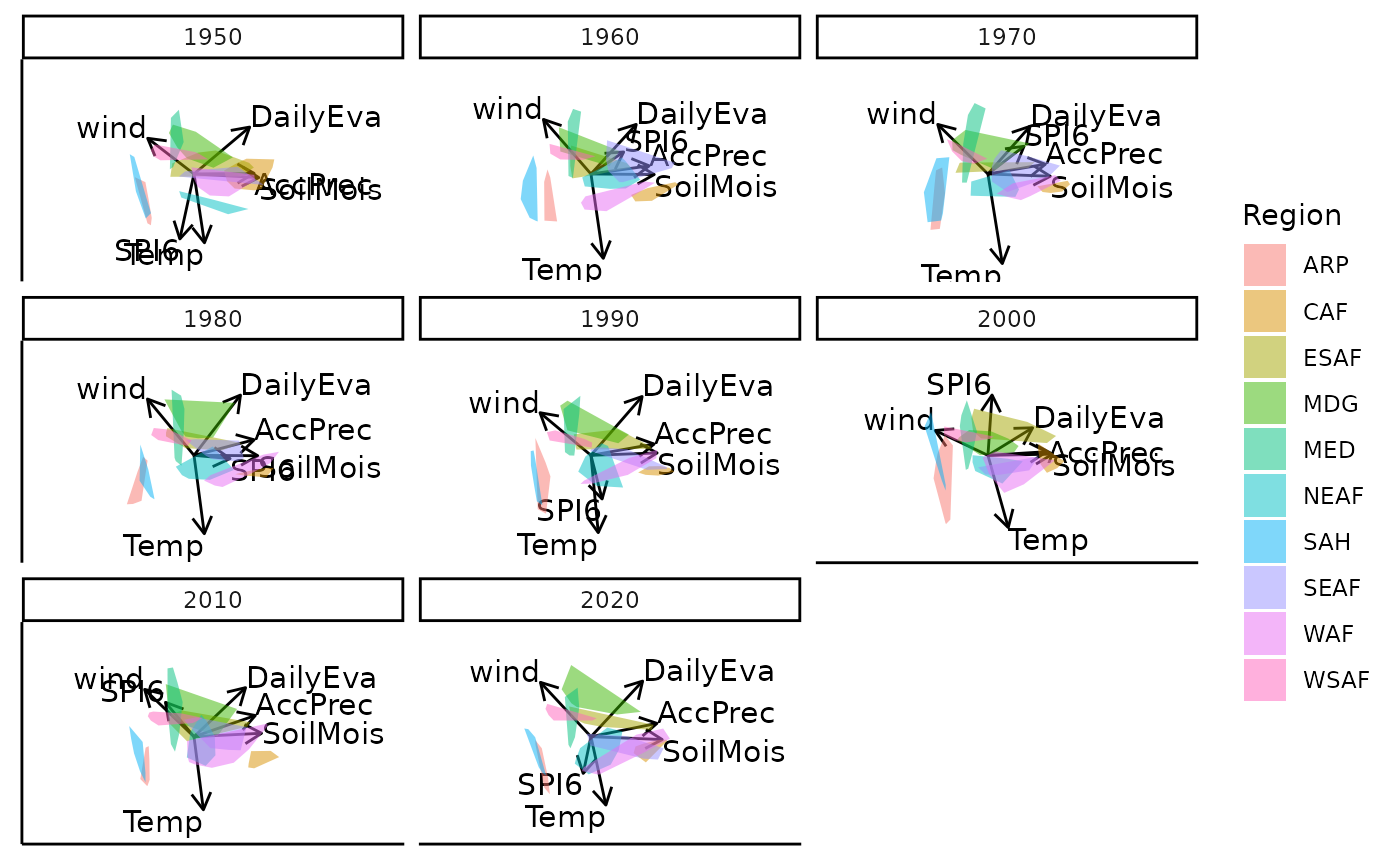 #> Object of class biplot, based on 960 samples and 9 variables.
#> 6 numeric variables.
#> 3 categorical variables.
# \donttest{
if(interactive()) {
bp |> moveplot3(time.var = "Year", group.var = "Region", hulls = TRUE,
move = TRUE, target = NULL)}# }
bp |> moveplot3(time.var = "Year", group.var = "Region", hulls = TRUE,
move = FALSE, target = Africa_climate_target)
#> Object of class biplot, based on 960 samples and 9 variables.
#> 6 numeric variables.
#> 3 categorical variables.
# \donttest{
if(interactive()) {
bp |> moveplot3(time.var = "Year", group.var = "Region", hulls = TRUE,
move = TRUE, target = NULL)}# }
bp |> moveplot3(time.var = "Year", group.var = "Region", hulls = TRUE,
move = FALSE, target = Africa_climate_target)
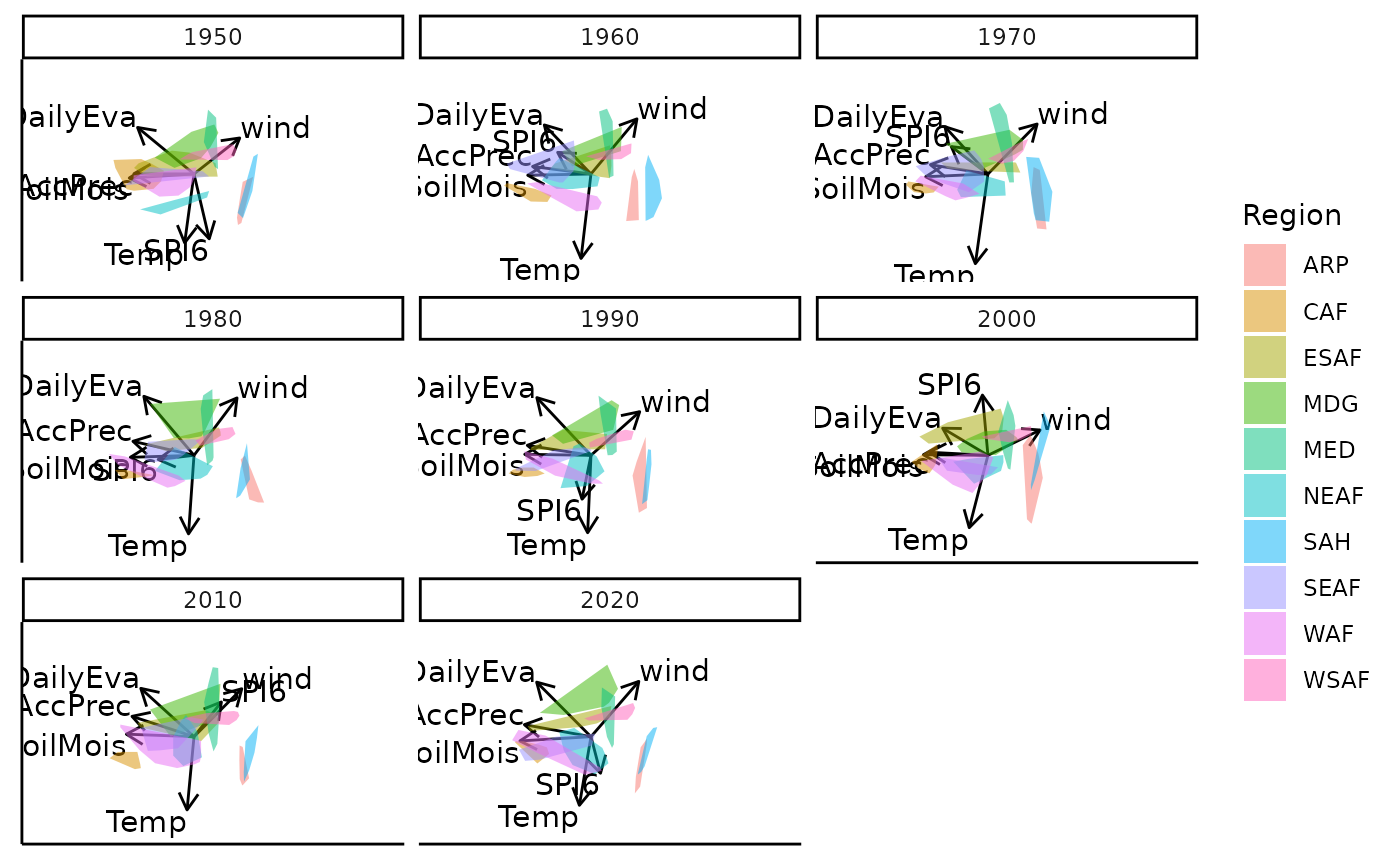 #> Object of class biplot, based on 960 samples and 9 variables.
#> 6 numeric variables.
#> 3 categorical variables.
#> Object of class biplot, based on 960 samples and 9 variables.
#> 6 numeric variables.
#> 3 categorical variables.